Time Entry Management Guide
User Guide
BriefSpec
Introduction
Time Entry is the BriefSpec feature used to record effort spent on project work. It helps project teams capture who worked on an item, what Activity the work belongs to, the date, the number of hours, whether the time is billable, and any supporting notes or work description.
Time entries are available at the Project level through the Time Entry tab and, where enabled, inside individual Service Requests. The project-level view supports logging time against several Project artifacts such as plan tasks, backlog items, phase requirements, test cases, test cycles, defects, service requests, action items, key decisions, RAID logs, and boards.
The information captured through Time Entry is used for tracking actual effort, comparing actual effort with estimates, reviewing billable and non-billable work, and supporting project billing controls where those controls are configured. Only users who are added to the Project (Project Users) can log time using the Time Entry tab feature.
Accessing Time Entry
Open the required project and select the “Time Entry” tab. The tab is part of the project workspace and is shown based on project configuration and user privileges.
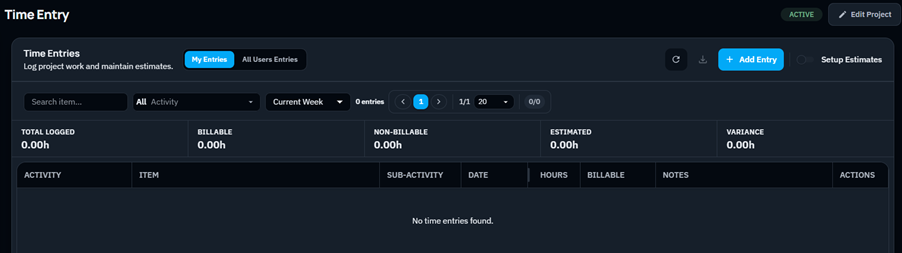
Users may also be taken directly to the Time Entry tab from project selection flows that are intended for time entry in the Left Hand side menu option. In that case, selecting a project opens the project details page with Time Entry already selected.
Understanding the Time Entry Screen
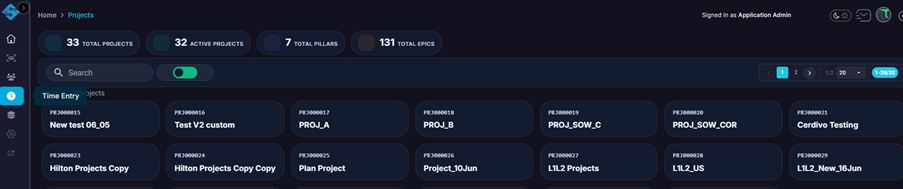
The project Time Entry screen shows a header, summary cards, filters, an optional entry form, and a table of saved entries. The same screen can be switched between Time Entry and Setup Estimates.
Summary Cards
The screen displays Total Logged, Billable, Non-Billable, Estimated, and Variance. Total Logged is the total number of hours in the current view. Billable and Non-Billable split the total by billing flag. Estimated shows matching setup estimates for visible items. Variance shows the difference between logged and estimated hours.
My Entries / All Users Entries
Users with permission to view all entries can toggle between their own entries and entries for all users. When All Users Entries is selected, a user filter is available.
Date Range
The date filter supports Current Week, Previous Week, Current Month, Previous Month, and Custom. Custom allows the user to choose a start and end date.
Activity Filter
The Activity filter allows users to narrow the table to one or more Activity areas. Selecting All clears the specific Activity filter.Only the Activities that a user has access to will be availablein the drop down. For example if a user does not have access to the ‘Service Request’ tab, it will NOT be available in the drop down.
Search
Search can be used to find rows by visible values such as Item, Item title, Activity, Sub-Activity, or notes.
Pagination
The table supports page navigation and page-size selection. Available page sizes are 5, 10, 20, 50, and 100 rows.
Activities and Work Items
Activities categorize the work being logged. BriefSpec seeds the default Activity list for each tenant so users can log time consistently across project modules.
Plan – project plan tasks and milestones.
Backlog – backlog requirements and RTMs.
Phase – phase requirements and sprint stories.
Test Case – generated or authored test cases.
Test Cycle – test cycle scripts and tester assignments.
Defect – project defects assigned to or created by the user.
Service Request – service requests assigned to, requested by, or created by the user.
Action Item – project action items assigned to or created by the user.
Key Decisions – key decision items involving the user.
RAID Logs – risks, assumptions, issues, and dependencies involving the user.
Boards – project board cards assigned to or created by the user.
The Item field is populated from the selected Activity. The list is searchable and is scoped to the project and user context. If the required item is not available, users can create a manual item label and save the time entry against that manual item.
Creating a Time Entry
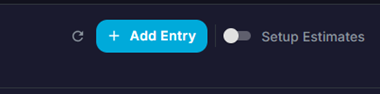
Click the Add Entry button on the Time Entry tab to open the New Time Entry form. Complete the required fields and click “Save Time Entry“.
Activity
Select the type of work being recorded, such as Plan, Backlog, Defect, Service Request, or Test Case. The selected Activity determines which project items appear in the Item field.
Item
Select the project item that the work relates to. Use the item search field to find items by ID or title. If needed, enter a manual item label when the work does not map to an existing artifact.
Sub-Activity
Enter or select the specific kind of work performed. Default sub-activities are provided for each Activity, such as Planning, Backlog grooming, Defect triage, SR analysis, or Board review. A newly entered sub-Activity is saved and becomes available for reuse.
Date
Select the date on which the work was performed. A valid date is required.
Hours
Enter the effort in hours. For project-level time entries, the value must be at least 0.25 and cannot be more than 24 for a day. The value is saved to two decimal places.
Billable
Use the Billable toggle to mark the entry as Billable or Non-billable. This supports reporting and billing review.
Notes
Enter optional notes to explain the work performed. Notes are searchable in the project-level Time Entry table.
After saving, the system confirms that the time entry was added and refreshes the table and summary cards.
Setup Estimates
The Time Entry screen can be switched to Setup Estimates. Setup Estimates capture expected effort for an Activity and Item before or alongside actual time entry.
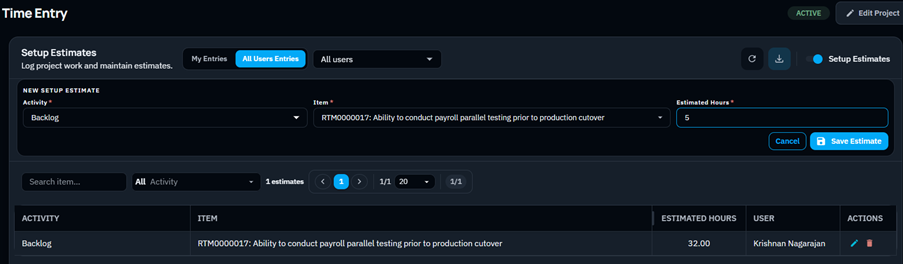
This helps the team compare planned effort with actual logged effort.
Setup estimates are currently optional in the frontend configuration for an Activity & Item.
Activity
Select the Activity for the estimate.
User
Select the user whose estimate is being captured.
Item
Select or manually enter the item being estimated.
Estimated Hours
Enter the expected hours. The estimate must be at least 0.25 hours.
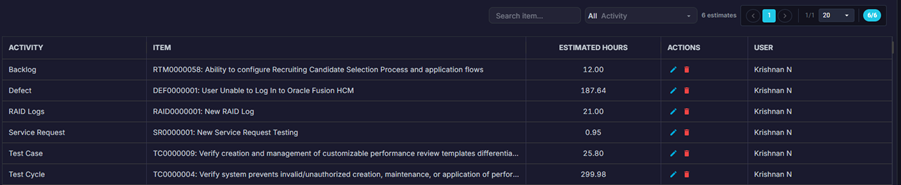
Saved estimates appear in the Setup Estimates table. The estimate table shows Activity, Item, Estimated Hours, User when applicable, and Actions when the user has update or delete privileges.
Viewing, Editing and Deleting Time Entries
Saved project-level entries are shown in a table with Activity, Item, Sub-Activity, Date, Hours, Billable, Notes. Users with update or delete privileges see action buttons on each row.

Click Edit to load an existing time entry into the form. Update the required details and click “Update Time Entry”. The same validations used during creation apply during editing.
Click Delete to remove an entry. BriefSpec displays a confirmation dialog before deletion. If the entry being deleted is currently open in the form, the form is reset after deletion.
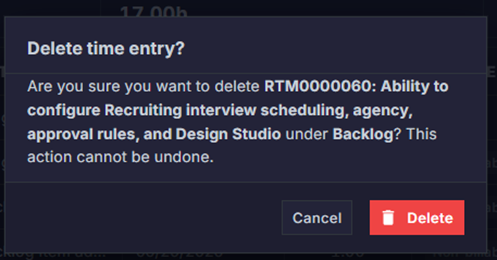
Role privilege conditions may limit editing or deleting to entries owned by the current user. If a user does not have permission, the action is disabled.
Service Request Time Entries
Time can also be logged inside an individual Service Request when the Time Entries tab is visible and the user has permission. This view is focused on the selected service request rather than the full project.
The Service Request Time Entries tab displays Total Logged, Billable, Non-Billable, Estimated, and Variance cards. The Estimated value comes from the service request’s Estimated Hours field. The Variance shows the difference between actual logged time and the estimate.
Filters
Use All Entries, Billable Only, Mine, and This Week to narrow the service request time entries. Entries are grouped by date and each date group shows the total hours for that day.
Add Time Entry
Click “+ Add Entry” to open the form. Enter Date, User, Hours, Billing, and Work Description, then click “Save Entry”.
Date
The date is required and defaults to today when starting a new entry.
Hours
Hours are required and are accepted up to two decimal place in the service request time-entry form. The value must be greater than zero.
Billable
Use the Billable toggle to mark the service request time as Billable or Non-Billable.
Notes
Work Description is optional. It describes the work performed.
Only users with the required Service Request time-entry privilege can add or edit entries. The backend also enforces ownership for edit and delete operations, so only the creator can edit or delete a Service Request time entry.
When a Service Request time entry is saved, BriefSpec records the action in the Service Request Activity stream and updates the service request time-entry list. Actual effort is reflected from the saved time entries.
Other Time Entries
In a similar manner time can be captured for other Activities like Action Items, Defects, RAID logs etc.
Permissions
Time Entry uses role-based privileges. Project-level Time Entry has separate Add, View, Update, and Delete feature privileges. Each privilege may be available for all entries or limited to the user’s own entries, depending on the project role configuration.
If View is hidden, users cannot access the Time Entry screen. If Add is read-only or hidden, users cannot create new entries. If Update or Delete is read-only, hidden, or limited to own entries, edit and delete actions are restricted accordingly.
Service Request time entries use the Service Request time-entry feature privilege. Users may see the Time Entries tab as read-only, may be able to add entries, or may be blocked from acting on entries they do not own.
Validation and Common Messages
The system validates required fields before saving. Missing or invalid fields display a message so the user can correct the entry.
Select an Activity – shown when Activity is missing on a project-level entry or estimate.
Enter or select an item – shown when no item or manual item label is provided.
Enter or select a sub-Activity – shown when a project-level time entry does not include sub-Activity.
Select a date – shown when the entry date is missing.
Hours must be at least 0.25 – shown for project-level entries or estimates below the minimum.
Hours cannot be more than 24 – shown for project-level entries above the daily maximum.
Date and hours are required for a time entry – shown on the service request time-entry form when either value is missing.
Work Description is required for a time entry – shown on service request entries when the description is empty.
You do not have permission to edit this time entry – shown when a user attempts an action outside their permission scope.
Recommended Usage
Use a specific Activity and Item whenever possible so time can be traced back to the Project artifact that drove the work.
Use clear sub-Activity names such as Defect triage, SR implementation support, Review support, or Test data preparation. Consistent naming improves reporting and reduces duplicate sub-activities.
Enter hours on the day the work is performed, or use the date filter to review and update recent entries. Avoid using one large entry for unrelated work across multiple artifacts.
Use setup estimates when the team needs planned-versus-actual tracking for important items. Estimates make the variance card meaningful and help project leads identify items that are consuming more effort than planned.
Review Billable and Non-Billable totals regularly with the project lead or billing owner so that client-facing effort is captured correctly.