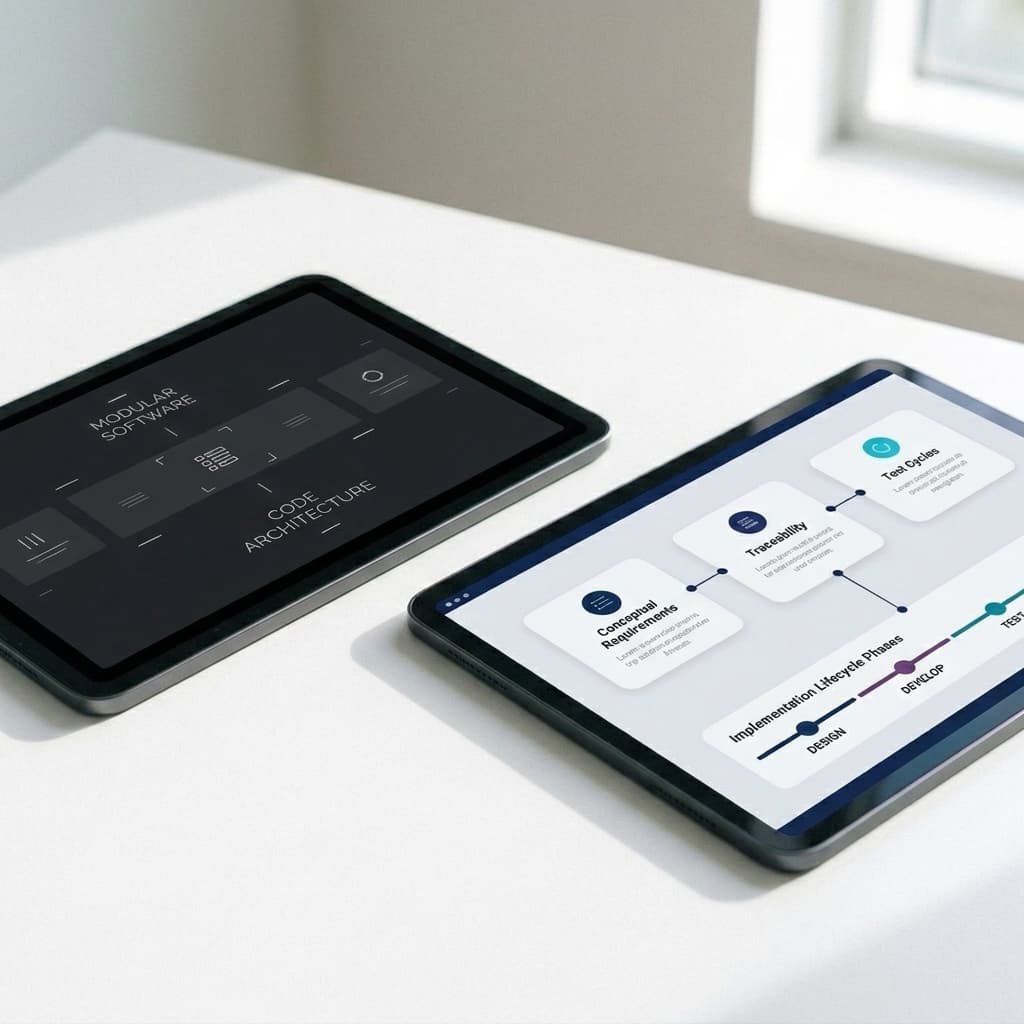
For a long time, enterprise software implementations have been treated almost like an extension of software development. But the underlying project models are different. A software development project typically operates in a relatively short loop: define what needs to be built, write the code, review it, iterate, and release. An enterprise software implementation has a longer and more interconnected lifecycle. The software already exists. The work is about understanding the business, making design decisions, configuring the platform, converting data, building integrations and reports, managing changes, testing end-to-end processes, and getting the organization ready to operate differently. The center of gravity is not code. It is decisions and solution design.
Software development vs. enterprise software implementation: software development usually centers on building or changing a product, while enterprise software implementation centers on adapting an existing platform to business processes, data, integrations, controls, testing, and operating change.
What software development projects optimize for
Software development projects are usually organized around product requirements, architecture, code, issues, releases, and deployment. Even when the project is complex, the work often moves through a build-oriented rhythm: backlog refinement, development, code review, testing, release, and monitoring.
That does not mean software development is simple or isolated from the business. Enterprise engineering work can involve security, uptime, integrations, compliance, adoption, and significant stakeholder coordination. But the primary production artifact is still software that is being built or changed.
What enterprise software implementations optimize for
Enterprise software implementation is the end-to-end process of configuring, integrating, testing, deploying, and adopting an enterprise platform such as Oracle Cloud, Workday, SAP, UKG, ADP, Salesforce, or a similar business system. The platform provides a product foundation, but the implementation determines how that product will support the organization.
That shifts the work toward business requirements, functional design, configuration choices, data conversion, integrations, reporting, security, testing, change management, sign-off, and go-live readiness. The most important question is not only whether something was built. It is whether the agreed requirement is reflected in the configured solution, validated through testing, accepted by the business, and ready for operational use.
| Dimension | Software development | Enterprise software implementation |
|---|---|---|
| Primary objective | Build or change software functionality | Configure and operationalize an existing enterprise platform |
| Core artifacts | Backlog items, code, pull requests, builds, releases | SOW, scope, requirements, design decisions, configurations, test cases, defects, approvals |
| Lifecycle | Plan, build, test, release, iterate | Scope, discover, design, configure, convert, integrate, test, remediate, train, deploy, support |
| Key stakeholders | Product, engineering, QA, DevOps, security | Business owners, PMO, solution architects, consultants, testers, data owners, security, change leads |
| Main risks | Defects, technical debt, missed product needs, release instability | Scope gaps, poor traceability, incomplete testing, data issues, adoption risk, go-live readiness gaps |
| Evidence needed | Code history, test results, release notes, issue status | Requirements coverage, test execution, defect resolution, approvals, sign-off, audit-ready traceability |
Why generic project tools create lifecycle gaps
That difference has a major impact on how these projects are managed. Many implementation teams rely on tools originally designed for software development, product management, or generic project tracking, so they spend years bending them to fit. Requirements may sit in one platform, design documents somewhere else, integrations in another repository, decisions in meeting notes, project plans in Smartsheet or Excel, and approvals buried in email or Teams.
Each tool may do its job reasonably well, but the project itself becomes fragmented. The bigger problem is not the number of tools. It is the loss of traceability across the lifecycle—being able to follow a business requirement through the decisions, solution design, configuration, test cases, defects, approvals, and downstream deliverables that came from it.
For example, a payroll requirement may originate in the Statement of Work, be clarified during discovery, affect configuration in the payroll module, require a data conversion rule, trigger an integration change, appear in SIT and UAT test cases, generate one or more defects, and require business sign-off before go-live. If those artifacts live in separate spreadsheets, documents, trackers, and message threads, the team may know the information exists somewhere but still struggle to answer a basic question: has this requirement actually been delivered and validated?
Why AI needs implementation context
This distinction also helps explain why generative AI’s early, highly visible use cases appeared in software development, especially code generation and app prototyping. Coding was an obvious use case. Tools such as Cursor, Lovable, and Bolt could generate, rewrite, and accelerate code early on.
But generating code addresses only a relatively small part of an Oracle, Workday, SAP, or Salesforce implementation. Much of the difficult work happens in conversations, design choices, dependencies, test coverage, exception handling, and business decisions. AI has to understand the context of the implementation and connect information across the lifecycle before it can make a meaningful difference. That is a different problem from simply producing code faster.
In implementation work, AI is most useful when it is grounded in live project context: the SOW, requirements, workstreams, project phases, test cases, test execution results, defects, ownership, decisions, and approvals. Without that connected context, AI can draft content, but it cannot reliably answer implementation questions such as which requirements lack test coverage, which defects block a workstream, or which scope items still need business approval.
What purpose-built implementation execution requires
Enterprise implementation teams need more than a task list. They need a structured and traceable execution model that connects the work from scope through go-live. At a minimum, that means:
- Structured requirements that can be traced back to source documents such as the SOW, discovery notes, and design decisions.
- Connected project plans and phases that show how workstreams, milestones, ownership, and delivery progress relate to scope.
- Formal test cycles for SIT, UAT, regression testing, payroll parallel testing, and readiness testing.
- Requirements-to-test traceability so teams can see which requirements are covered, executed, passed, failed, or blocked.
- Defect management that links issues back to requirements, test cases, owners, severity, and go-live impact.
- Implementation intelligence that lets project teams ask questions against live project data instead of manually reconciling spreadsheets and documents.
This is where the implementation project model diverges most clearly from the software development project model. A development team may ask what needs to be built next. An implementation team also has to ask what was agreed, what changed, what was configured, what was tested, what failed, who approved it, and whether the business is ready to operate with the new process.
The project model matters before the AI model
I think this is the distinction we often miss when discussing the future of enterprise project execution. In many cases, software development centers on building or changing a product, while enterprise software implementation centers on adapting an existing platform to business processes, data, integrations, controls, and operating change. The workflows, information, dependencies, and evidence that need to be managed are fundamentally different.
Yet teams often continue to run both using largely the same class of tools—and then fill the gaps with more spreadsheets, more trackers, and more manual coordination. Before asking how AI will transform enterprise implementations, we first need to acknowledge that these projects were never simply software development projects to begin with.
If your implementation requirements, test cases, defects, decisions, and project status are spread across spreadsheets and task trackers, BriefSpec provides a connected implementation workspace built for traceability from scope through go-live. BriefSpec helps enterprise implementation teams connect requirements, project plans, testing, defects, documentation, and implementation intelligence in one place, with AI grounded in actual project data and governed by human review.
FAQ
Is enterprise software implementation the same as software development?
No. Software development typically focuses on building or changing software. Enterprise software implementation focuses on configuring, integrating, testing, deploying, and adopting an existing platform so it supports agreed business requirements and operating processes. Implementation projects may include development work, but they are not primarily code-production projects.
Why do ERP and enterprise software implementations need traceability?
Traceability connects scope and requirements to design decisions, configuration, test cases, test results, defects, approvals, and go-live evidence. Without traceability, teams struggle to prove whether requirements were delivered, whether testing coverage is complete, and whether open issues create business or go-live risk.
How is AI different in implementation work than in coding?
In coding, AI can assist directly with generating, editing, and explaining code. In enterprise implementation work, AI needs connected project context. It must understand requirements, workstreams, configurations, test cycles, defects, decisions, and approvals to support useful implementation intelligence rather than producing isolated drafts.