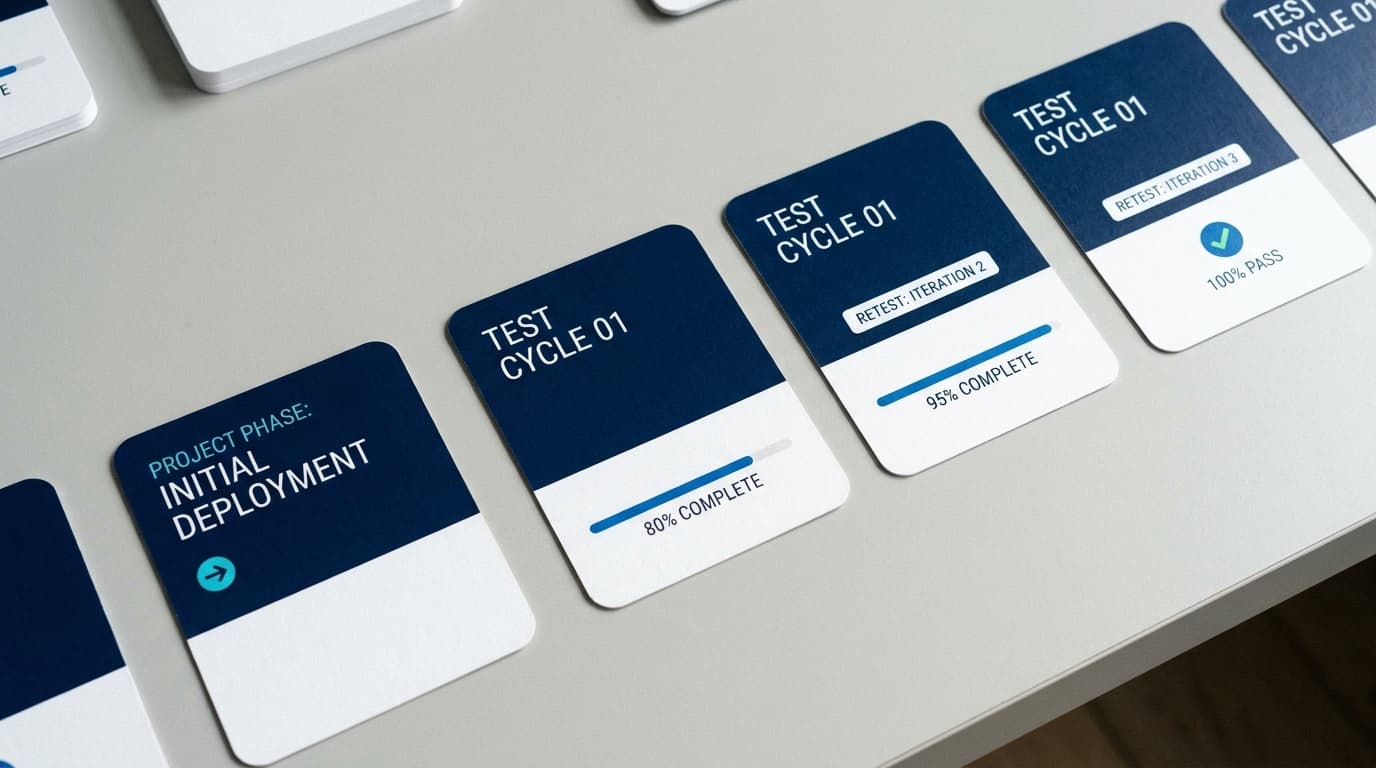
Why software retests happen more than anyone plans for
By Arideep Mukherjee, Founder, BriefSpec · 7 minute read
In short: In many enterprise software implementations, software retests are common enough that they should be planned for rather than treated as exceptions. Vendor releases, environment refreshes, late design changes, tester turnover, audit findings and failed cycles all send a project back to re-execute tests it had already marked done. On spreadsheets that often means rebuilding the tracker and redistributing files. In dedicated test tools it is better, but implementation-specific context such as assignments, workstreams, instructions and traceability can still require manual setup. This article covers why retests happen more often than the plan admits, what a clean re-run should preserve, and how BriefSpec clones a test cycle, in whole or in part, so the retest can start quickly without rebuilding the cycle from scratch.
What is a software retest?
A software retest is the re-execution of one or more test cases after a defect fix, release, environment change, data change, audit issue or scope change to confirm that the result is still valid. In enterprise software implementations, the word often means more than verifying a single bug. It can mean rerunning all or part of a formal SIT, UAT, regression, payroll parallel or readiness test cycle with a fresh execution status.
| Term | Meaning | Typical enterprise implementation use |
|---|---|---|
| Retest | Run specific cases again to validate a fix, change or previously invalid execution. | Re-run failed UAT cases after defects are fixed, or re-run affected cases after a data reload. |
| Regression testing | Run selected coverage to confirm a change did not break related functionality. | Re-run payroll, benefits and integration cases after a vendor release or configuration change. |
| Cycle rerun | Run a full or partial formal test cycle again from a blank status. | Repeat UAT cycle 1 as UAT cycle 2 because the business did not accept the first cycle. |
Every implementation plan I have seen has one line for system testing, one for acceptance testing, and maybe a line for a parallel run before go-live. None of them have a line for “acceptance testing, cycle 2, because the customer did not accept cycle 1.” Yet on most of the enterprise programs I worked on over 23 years, that second cycle happened, and on a few of them a third one did too.
The trigger is usually blunt. Cycle 1 finishes with too many open defects, or with pass marks the business does not trust, and the customer’s program lead says the words every project manager dreads: we want the entire cycle run again, and they mean every case, including the ones that passed.
The request is reasonable. What is unreasonable is how much work it takes to say yes.
Why retests happen in enterprise implementations
A failed cycle is the obvious reason, but it is not the only one. Once you list the others, it becomes clear that re-execution is a normal part of delivery rather than an exception.
One frequent trigger is the vendor’s scheduled release. Many major cloud enterprise platforms publish regular release calendars, and those releases can land during or between formal test cycles. If one lands in the test environment between system testing and acceptance testing, the customer’s change-control policy may require some or all previously signed-off cases to be re-executed, especially where audit evidence must tie to the current build. An environment refresh can also invalidate the assumptions or data behind prior executions. Even if the evidence remains, teams may need to repeat affected cases on the refreshed copy. Any embedded engine that updates on its own schedule, a tax engine or a pricing engine for example, has the same effect on the cases that depend on it, even when nothing else changed.
Design changes after testing has started are the second family. A late change request, a redesign of a core structure that dozens of other configurations hang off, a re-load of converted data with corrected legacy records. In each case the implementation partner cannot credibly say “only these ten cases are affected” without regression coverage, so the customer asks for the dependent part of the cycle, or all of it, to be redone. A third-party integration changing its file layout mid-project reopens every end-to-end case that crosses that boundary.
Then there are the people reasons. A tester leaves and the person who replaces them inherits someone else’s pass marks. Most refuse to own them, and they are right to refuse. Sometimes an internal audit finds that the first execution was not done properly: results recorded without evidence, wrong test data, steps skipped. The cycle is invalidated and has to be run again by different testers.
Some retests are scheduled by design. A payroll or billing go-live plan often calls for two or three parallel runs against the legacy system, and each one is the same set of cases executed again from a blank status. Year-end is another, where cases executed in the second quarter are repeated after regulatory updates are applied. A go-live slip of a few months triggers one too, because by then the environment and the configuration have drifted and nobody trusts the old results.
Finally, scope grows. A phased rollout adds a legal entity, a country or a business unit after the first cycle has closed, and the original cases need to be run for the new population.
Most of these are partial retests. The hard part in the spreadsheet world was never the re-execution. It was working out which subset to reissue and getting it to the right people.
What a re-run looks like today
On a spreadsheet-run project, a retest begins with the project manager opening the master tracker, copying it, clearing every status and comment column, and saving it under a new name. Then they split it up again by tester, re-send the files, re-explain the instructions, and start the reconciliation routine over. If the retest is partial, someone has to filter the master by the right module or by the failed rows, and hope the filter matches what the customer meant. I have watched this take two full days before a single test was re-executed, and by the time the sheets were out, a couple of testers had changed since the first cycle and their cases had no owner.
Dedicated test tools improve on that, and it is fair to be specific without overstating the comparison. Tools such as TestRail can reduce the work for status-based reruns and are strong for test case and test run management. In implementation programs, though, retest scope often needs to follow delivery structure: workstream, module or epic, cycle instructions, original business tester assignments, requirements, defects and traceability. Depending on how the project has been modeled, some of that structure may require custom fields, conventions or manual setup.
Xray for Jira gives teams the power of Jira and Xray modeling, including Test Plans, Test Executions, issue fields and JQL. That power can be useful, but retest setup often depends on those modeling decisions. In practice, a project manager may rebuild retest scope from a Test Plan or Jira query rather than cloning the prior implementation cycle with every instruction, assignment and execution context preserved.
So even when a team has a dedicated test tool, retesting can still involve scope decisions, reassignment and context rebuilding. If the project is on spreadsheets, it can easily become a day or two of rebuild work before retesting starts.
What a clean retest cycle should preserve
A clean retest cycle should not overwrite the prior result. It should create a new execution record while preserving the implementation context that made the first cycle meaningful.
- Scope: the exact test cases included in the full or partial retest.
- Ownership: the team, tester and workstream assignments for each case.
- Instructions: the brief, evidence requirements, environment notes and data set guidance for the new cycle.
- Traceability: the links between requirements, test cases, defects and execution results.
- Prior evidence: the original cycle’s pass, fail, blocked and not-run results remain intact for audit and comparison.
- Fresh execution status: the new cycle starts blank so the team can measure the retest separately.
How BriefSpec clones a cycle
In BriefSpec, a test cycle is part of the connected implementation record. It holds the teams and their members, the test cases, the instructions the testers were given, the assignments that say which tester owns which case, and every execution result. It also sits alongside requirements, defects, project phases and traceability, so testing is not isolated from the rest of the implementation lifecycle. Cloning a cycle means cloning that structured object, and choosing how much of it comes along.
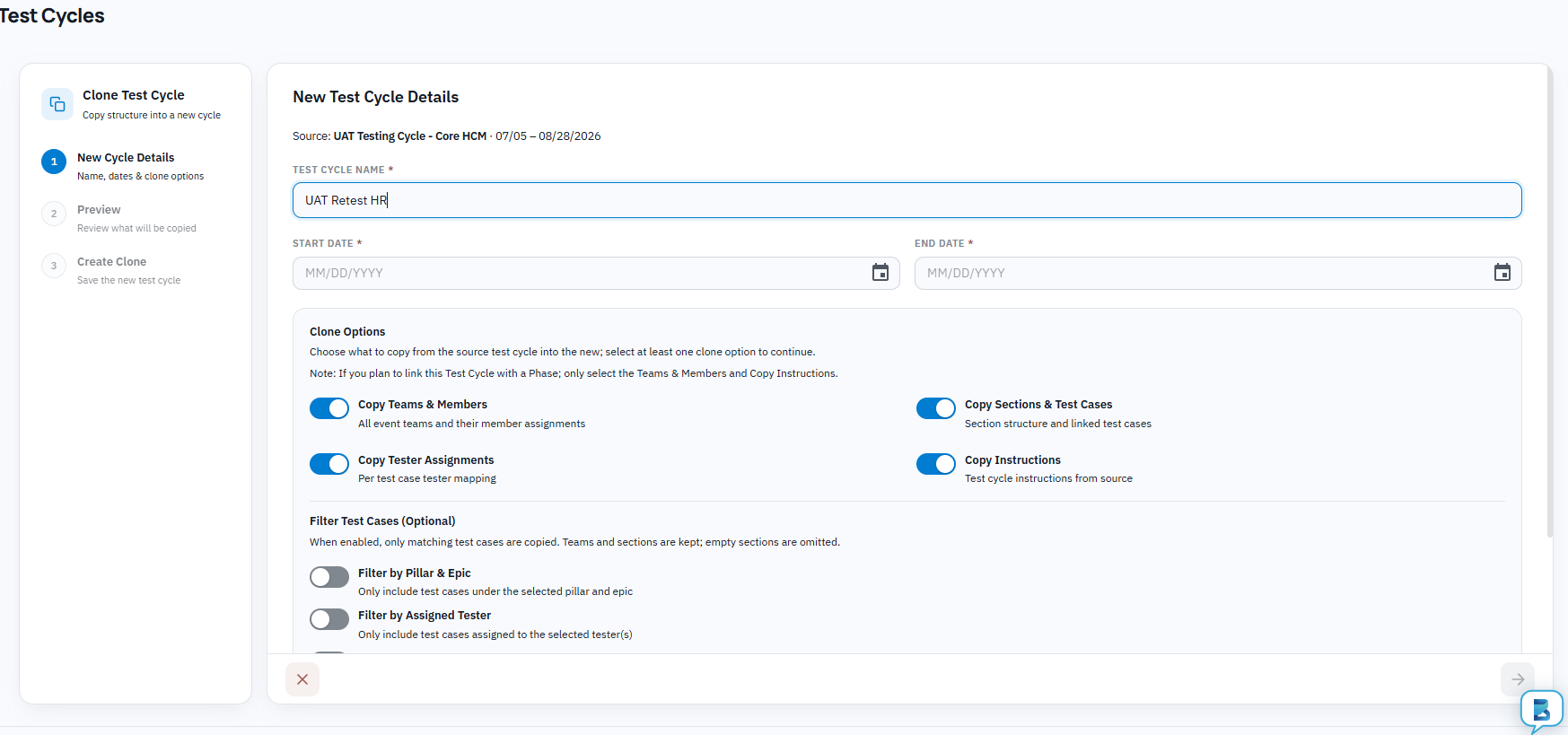
Cloning a cycle is handled in one dialog. Everything the original cycle knew about who tests what comes with it.
A full clone brings everything: the teams and team members exactly as they were, every test case, the instructions, and every assignment, with the execution status of every case reset to blank. That is the “run the entire cycle again” request answered without rebuilding the tracker. The testers who ran cycle 1 find cycle 2 in their queue with the same cases, and the project manager’s live view starts at zero without a single sheet being redistributed.
A partial clone applies filters before the copy. You can bring in only the cases belonging to a workstream or an epic, which is how you answer “re-run payroll after the redesign” without touching benefits or core HR. You can bring in only the cases assigned to a specific tester, which is how you hand a departed tester’s caseload to their replacement as a clean cycle, or re-run one person’s work after an audit finding. And you can bring in only the cases with a given execution status, which is the familiar “failed and blocked only” retest, except the assignments and the team structure come with it.
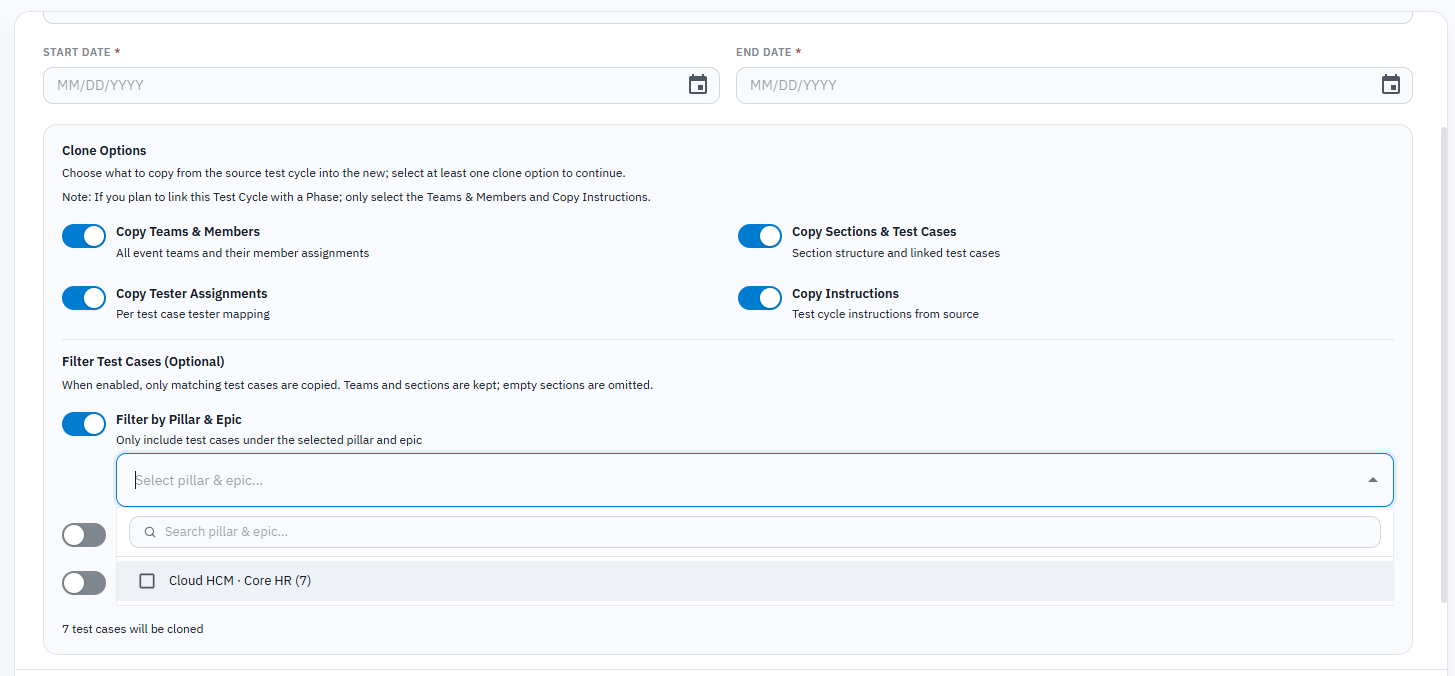
Filters can combine by workstream, epic or module, tester and execution status, so the retest scope reflects the implementation structure.
The instructions can be edited on the clone before it is released, because a retest usually has a different brief from the original: this time, attach evidence for every step, or this time, use the refreshed data set.
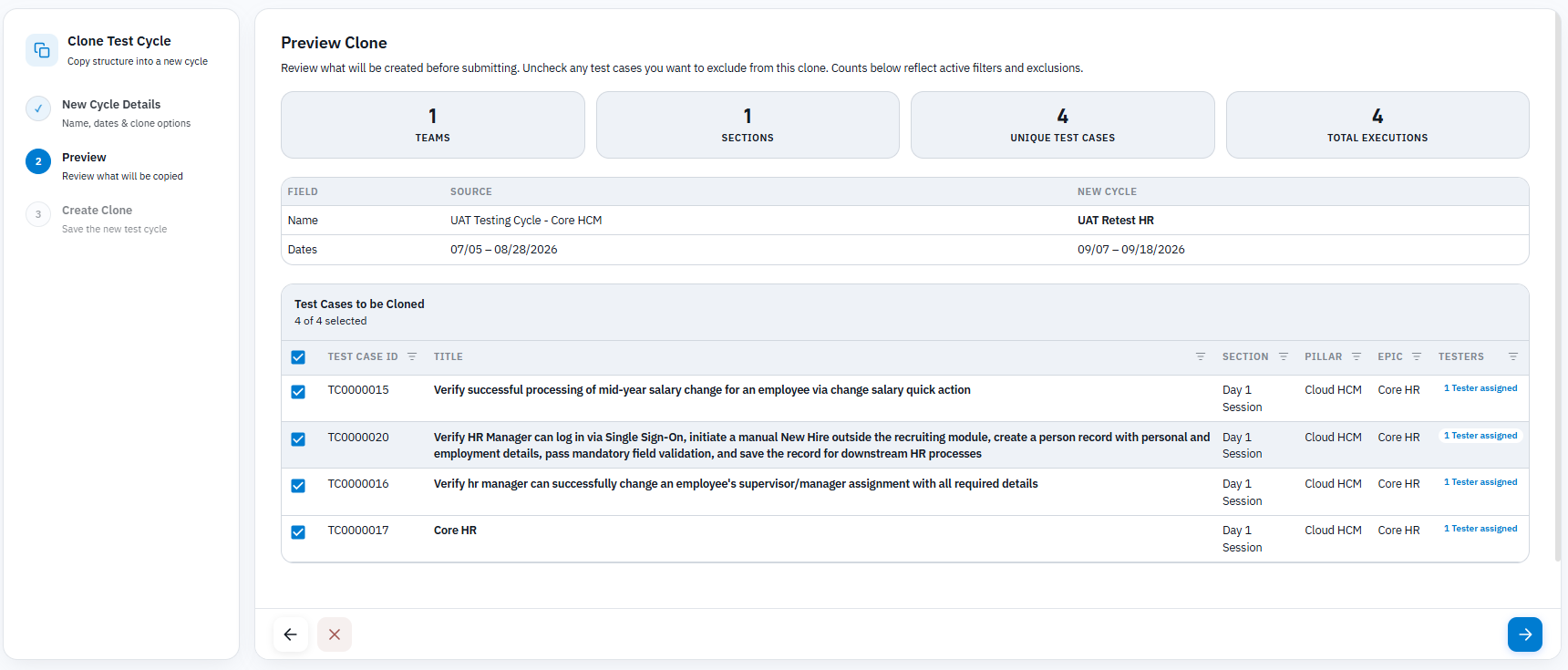
Because each cycle is its own object, cycle 1 keeps its results. Nothing is overwritten. The trace from requirement to test case to defect to retest is intact, which is what an auditor asks for and what a steering committee needs when it wants to know whether cycle 2 actually improved on cycle 1.
What changes for the project
The practical effect is that a retest stops being a project management event and becomes a configuration step. When the customer asks for the whole cycle again, the answer is yes, and the cycle can be live the same day. When a vendor release lands, the regression retest is a filtered clone of the last cycle rather than a fresh build. When a tester leaves, their cases move to a new owner as a cycle of their own, and the new person starts with a clean slate and the original instructions.
None of that removes the reason for the retest. The defects are still real and the release still has to be tested. What it removes is the rebuild work that used to sit between the request and the first re-executed case, and the assignment errors that used to surface a week later when someone noticed nobody owned the day-two cases.
Software retest FAQ
Why do retests happen in UAT?
UAT retests happen when business users cannot accept the first execution result. Common reasons include open defects, missing evidence, late configuration changes, refreshed test data, vendor releases, tester turnover or scope changes that affect previously tested processes.
Should passed test cases be retested?
Sometimes. If the change is narrow and evidence is strong, a project may retest only failed or affected cases. If the environment, release, data set or core design changed, the customer may reasonably ask for passed cases to be re-executed as part of regression or acceptance coverage.
What should be copied into a retest cycle?
A retest cycle should copy the relevant test cases, team assignments, tester ownership, cycle instructions, workstream or module context, requirement links, defect links and evidence expectations. It should not overwrite the original execution result.
How is a retest different from regression testing?
Retesting verifies that a specific failed or affected item now works. Regression testing checks whether a fix, release or configuration change broke related functionality. In enterprise implementations, the two often overlap because a defect fix or vendor release can require both targeted retesting and broader regression coverage.
If your team is preparing for SIT, UAT, regression testing or a payroll parallel run, BriefSpec can help preserve cycle scope, assignments, instructions, defects and traceability in one connected implementation workspace. Request a BriefSpec pilot to test cycle cloning on one active implementation or upcoming retest.